
Bible sizes compared: from Micro to Giant
Bible sizes have names (pocket, compact, personal, giant), but no standard measurements, and photos online all look the same size. This guide gives the real measurements of our King James (KJV) and Louis Segond (LSG) Bibles, shows them side by side at actual size, and explains which size fits where.
| Size | Cover (W × H × thickness) | Page | Type | Bibles |
|---|---|---|---|---|
| Micro (coming March 2027) | 3.4 × 5.6 × 1.1 in86 × 142 × 27 mm | 3.1 × 5.1 in80 × 130 mm | 5 point | KJV |
| 3.3 × 6.8 × 1.1 in84 × 172 × 27 mm | 3.1 × 6.3 in78 × 160 mm | 6 point | KJV | |
| Compact | 4.6 × 7.6 × 1.1–1.2 in118 × 194 × 28–30 mm | 4.4 × 7.2 in112 × 182 mm | 8 point | KJVLSG |
| Personal | 5.7 × 9.3 × 1.3–1.4 in144 × 236 × 34–36 mm | 5.4 × 8.8 in138 × 224 mm | 11 point | KJVLSG |
| Giant (coming July 2027) | 7 × 10.9 × 1.5 in178 × 278 × 37 mm | 6.4 × 10.4 in162 × 263 mm | 14 point | LSG |
See them at actual size
Our size chart draws the Micro, Compact, Personal and Giant Bibles at their real page size, each with a page of Genesis 1 in its real type size.
To see them at actual size, open the PDF in a PDF viewer (Adobe Acrobat Reader, Preview on a Mac) and set the zoom to 100% or “Actual size”. Screens differ, so check with a ruler: the Giant page should measure about 6.4 inches (162 mm) wide.
The Pocket edition is not in the chart: its pages are 3.1 × 6.3 inches (78 × 160 mm), about as wide as the Micro and 1.2 inches (30 mm) taller.
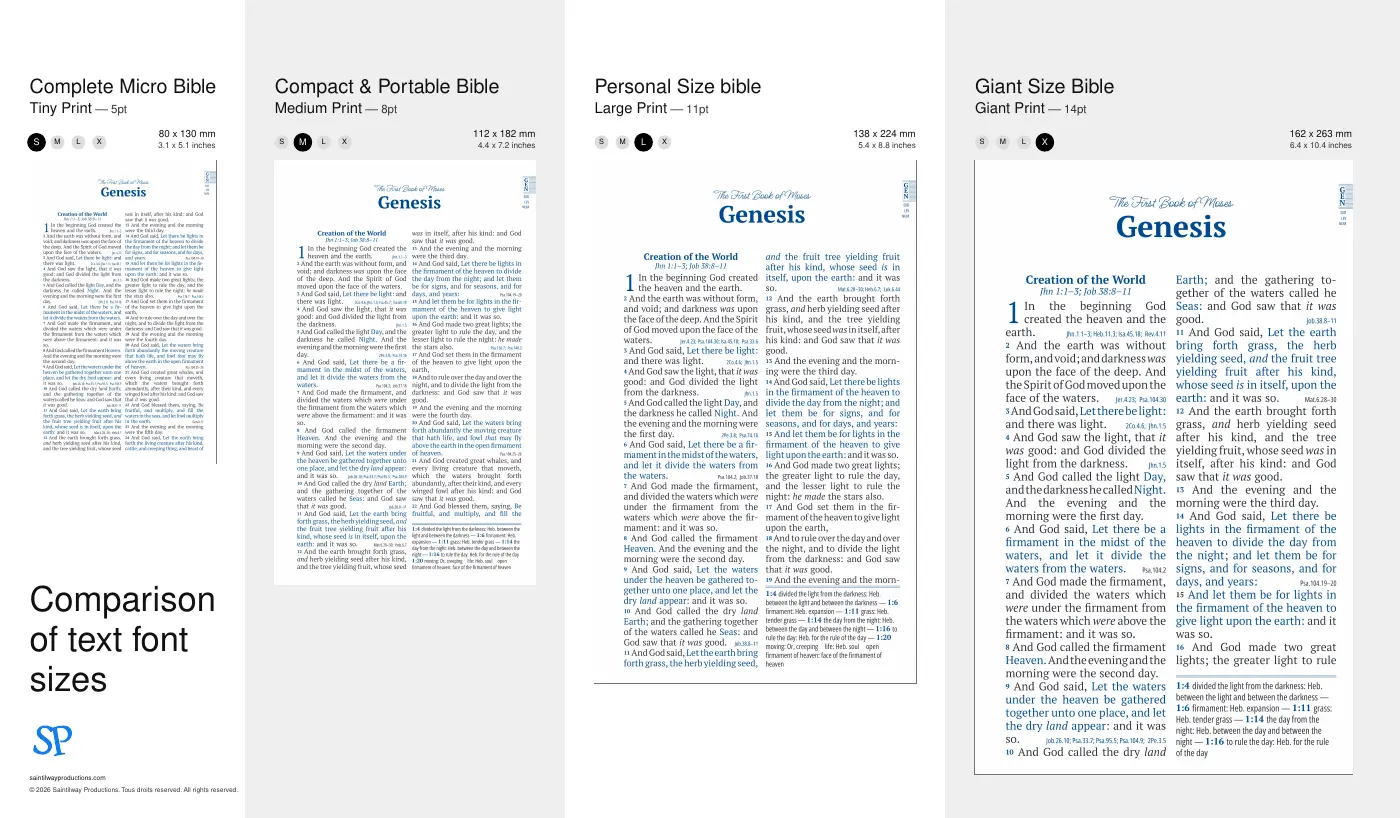
Open the size chart (PDF, about 10 MB)
The chart is 23.7 × 13.8 inches, larger than home printer paper, so it shows at actual size on a screen, not on a printed page.
Cover size vs. page size
A Bible’s cover is a little larger than its pages: it overhangs them to protect the edges. On our Bibles, the cover is about 6 mm wider and 12 mm taller than the pages, and 16 × 15 mm on the Giant.
Product pages give the cover size: that is what you need to know whether a Bible fits a pocket, a bag or a Bible cover. The chart above shows the page size, which is what you read on.
Where each size fits
- Micro (coming March 2027): the smallest. A jacket pocket, a small purse, a glove box or a travel bag. To carry every day and look up a verse.
- Pocket: tall and narrow, about the size of a large phone. A jacket pocket or a purse. A little larger type than the Micro.
- Compact: a purse or a small bag. Light enough to bring to church every week, comfortable enough for daily reading for many readers.
- Personal: a tote bag or a backpack. Large print, for daily reading and study at home and in church.
- Giant (coming July 2027): stays at home, on a reading chair or a desk. Giant print, for readers with low vision and for reading aloud.
How to choose
- Where will you read it? A Bible you carry every day should be small; a Bible that stays at home can be as large as you like.
- How easy is small type for you? Smaller Bibles have smaller type. If you wear reading glasses, start at the Personal size or larger.
- Will it be your only Bible? Many readers have two: a small one to carry and a larger one to read at home.
Why thickness changes less than you think
All our Bibles are complete, with all 66 books, so even the smallest is 1.1 inch (27 mm) thick. Larger type needs more pages (from 1,320 to 1,800), so thickness only goes from 1.1 to 1.5 inches (27 to 37 mm) across our sizes.
More guides
- How to choose a KJV pocket Bible
- How to choose a Louis Segond French Bible
- Large print Bibles: type sizes compared
Where to buy
Order on this website and we ship from Orlando, Florida, in 1–2 business days, anywhere in the US. Shipping is free on orders of $49 or more, and you can return an order within 30 days of delivery. Our Bibles are also in our Amazon store, at the same prices.
See our BiblesOrder for a church or a groupAsk us a question